


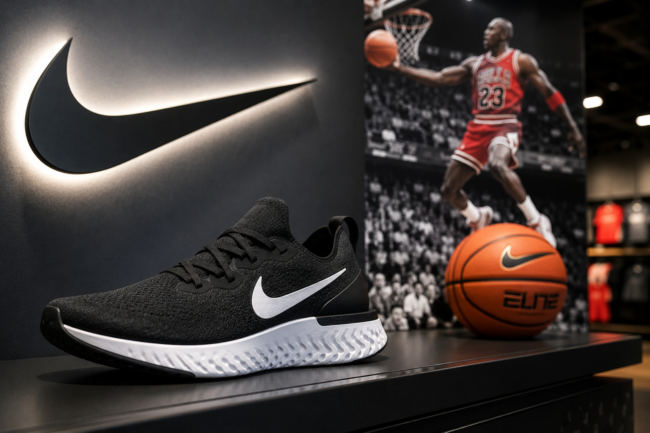
A pair of Nike sneakers might cost $100, $150, or considerably more.
But the materials inside the box aren’t what made Nike one of the biggest sports brands on Earth.
Nike built something much more valuable: a brand people recognize almost instantly.
That brand allows the company to sell sneakers, clothing, sports equipment and accessories through retailers, its own stores and digital platforms around the world.
In fiscal 2026, Nike generated approximately $46.4 billion in revenue.
So how does Nike turn sneakers and a famous Swoosh into tens of billions of dollars?
It starts with footwear.
Sneakers Are the Heart of Nike’s Business
Nike sells plenty of shirts, shorts and sports equipment, but footwear remains the company’s powerhouse.
Across Nike, Inc., footwear generated approximately $30.5 billion in fiscal 2026.
Apparel produced another $13.5 billion, while equipment contributed approximately $2.2 billion.
That means roughly two-thirds of Nike’s revenue came from footwear.
But Nike isn’t simply competing on who can manufacture a shoe.
It’s selling performance, design, culture and the Nike name attached to that shoe.
Nike Sells Through Other Retailers
Walk into a sporting goods store or major shoe retailer and there’s a good chance you’ll find Nike products.
That wholesale business remains enormously important.
Nike Brand wholesale revenue reached approximately $27.5 billion in fiscal 2026, up from $25.9 billion the previous year.
Wholesale allows Nike to put its products in front of shoppers without operating every store itself.
Retail partners buy and sell the merchandise while Nike benefits from their enormous distribution networks.
Nike Also Wants to Sell Directly to You
Nike doesn’t rely entirely on other retailers.
The company operates its own stores and digital platforms through Nike Direct.
Nike Direct generated approximately $17.7 billion in fiscal 2026. That included about $8.6 billion from Nike Brand Digital.
Selling directly gives Nike more control over how its products are presented and how it interacts with customers.
It also means Nike isn’t sharing the retail experience entirely with a middleman.
The strategy has limits, though.
Nike Direct revenue declined 6% in fiscal 2026 as digital and store traffic weakened, showing why maintaining multiple ways to reach customers still matters.
Jordan Became a Billion-Dollar Business Inside Nike
Michael Jordan hasn’t played an NBA game in decades.
His business relationship with Nike, however, is still producing billions of dollars in sales.
Jordan Brand generated approximately $7 billion in revenue for Nike in fiscal 2026.
The brand now extends far beyond basketball shoes.
Jordan products include athletic and casual footwear, clothing and accessories, turning a partnership originally centered around one basketball player into a global brand of its own.
That’s an extraordinary example of how valuable intellectual property and cultural relevance can become.
Nike Spends Billions Keeping the Brand Powerful
A famous brand doesn’t stay famous by accident.
Nike calls much of its marketing spending “demand creation expense.”
In fiscal 2026, that expense reached approximately $4.75 billion.
That money helps support advertising, sports marketing and the enormous ecosystem Nike has built around athletes and competition.
Nike has spent decades associating its products with some of the world’s most recognizable athletes.
The goal isn’t merely to show people a shoe.
It’s to make them want that particular shoe because of what the brand represents.
Athletes Help Sell the Story
Sports endorsements are a major piece of Nike’s identity.
Instead of competing only on materials and manufacturing, Nike connects products to elite athletes, major sporting events and memorable moments.
That strategy can transform an ordinary product category into something emotional.
A sneaker isn’t merely something covering your foot anymore.
It’s connected to basketball, running, fashion, an athlete or even nostalgia.
And consumers can be willing to pay more for that connection.
Human beings apparently needed emotional relationships with footwear, and Nike was smart enough to monetize the situation.
Limited Releases Create Demand
Nike has another powerful tool: scarcity.
Certain sneakers are released in limited quantities or tied to collaborations, athletes and special editions.
When demand exceeds supply, a product can become more desirable simply because it’s difficult to get.
That can create excitement around launches and keep consumers paying attention to upcoming releases.
The resale market has also demonstrated just how much value consumers can attach to certain Nike and Jordan sneakers, even though Nike doesn’t capture all of that resale money itself.
The frenzy still reinforces the cultural value of the brands.
Nike Is a High-Margin Brand Business
Nike reported approximately $19.9 billion in gross profit during fiscal 2026.
Its gross margin was 42.9%.
That doesn’t mean Nike keeps 42.9 cents of every dollar as profit. The company still has marketing, administrative and many other expenses to pay.
Nike’s actual net income for fiscal 2026 was approximately $3.1 billion.
But the gross margin illustrates something important.
A globally recognized brand can create significant value between what products cost to produce and what consumers are willing to pay for them.
Nike Isn’t Just Selling Products
Nike’s real advantage becomes clearer when you look beyond individual sneakers.
The company has built relationships with athletes.
It has apps and digital platforms.
It operates stores.
It sells through other retailers.
It owns globally recognized brands including Nike, Jordan and Converse.
And it has decades of sports history attached to its products.
Competitors can make sneakers.
Replicating that entire ecosystem is considerably harder.
What Businesses Can Learn
Nike demonstrates that a powerful brand can become an asset of its own.
The company still has to design products people actually want. Branding can’t rescue a terrible sneaker forever.
But when a good product is combined with recognizable design, cultural relevance, athlete partnerships and global distribution, customers may become willing to pay a premium.
Apple has built a similarly powerful relationship with its customers.
Its devices compete on technology, but the Apple name and interconnected ecosystem also influence why millions of customers continue buying its products.
In both cases, the product matters.
The brand surrounding the product can be worth billions.
Final Thoughts
Nike makes sneakers.
But that’s an incomplete description of the business.
Nike sells footwear, apparel and equipment through a global network of retailers, stores and digital platforms.
More importantly, it has spent decades turning sports, athletes, design and culture into one of the most recognizable brands in the world.
In fiscal 2026, that machine generated more than $46 billion in revenue.
The shoe is the product.
The brand is the empire.
That’s the real money behind Nike.
Frequently Asked Questions
How much money does Nike make?
Nike, Inc. generated approximately $46.4 billion in revenue and $3.1 billion in net income during fiscal 2026.
What is Nike’s biggest business?
Footwear is Nike’s largest product category. Nike, Inc. reported approximately $30.5 billion in footwear revenue during fiscal 2026.
How much money does Jordan Brand make?
Jordan Brand products generated approximately $7 billion in Nike Brand revenue during fiscal 2026.
Does Nike make more money selling directly or through other retailers?
Wholesale remains larger. Nike Brand generated approximately $27.5 billion from wholesale customers in fiscal 2026 compared with approximately $17.7 billion through Nike Direct.
Disclosure: This article may contain affiliate links. If you purchase a product through one of our links, MoneyNation may earn a small commission at no additional cost to you. Please read our Affiliate Disclosure.
Helpful Products
- Check this out on Amazon: Nike Backpack
- Check this out on Amazon: Nike Dri-FIT T-Shirt
- Check this out on Amazon: Nike Running Socks
- Check this out on Amazon: Shoe Cleaning Kit