
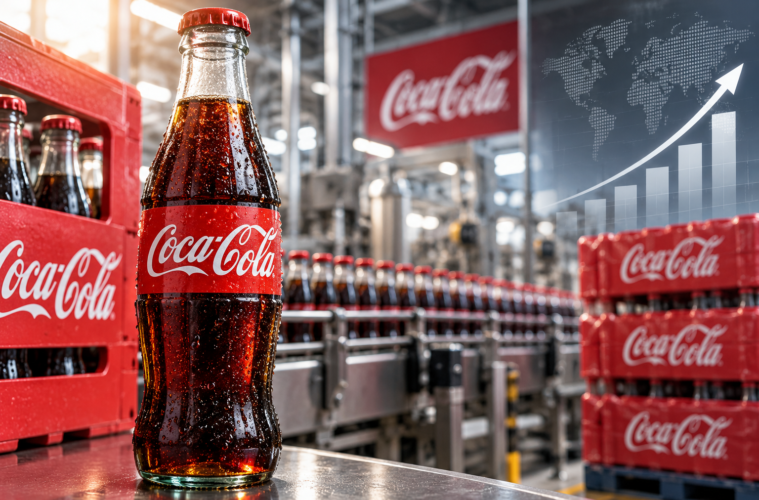
Coca-Cola might be one of the simplest products imaginable.
Flavored syrup. Carbonated water. A bottle or can.
Yet the business behind that drink generated nearly $48 billion in revenue in 2025.
And here’s the interesting part.
The Coca-Cola Company doesn’t personally manufacture and deliver every bottle of Coke sitting in a supermarket refrigerator.
Instead, it operates a global system of concentrates, bottling partners, distributors, retailers and some of the most recognizable beverage brands on Earth.
That system allows Coca-Cola to sell an extraordinary amount of beverages without having to own every factory and delivery truck involved.
So how does Coca-Cola really make its money?
The answer starts with what’s inside the bottle before the water is even added.
Coca-Cola Sells Concentrate
One of the most important parts of Coca-Cola’s business is concentrate.
The company manufactures and sells beverage concentrates, bases and syrups to authorized bottling partners.
Those bottlers then combine the concentrate with water and, depending on the product, sweeteners. They package the finished drinks in bottles and cans and distribute them to stores, restaurants and other customers.
In other words, Coca-Cola can make money from the valuable branded ingredient while bottling partners handle much of the capital-intensive work required to turn it into the drink customers actually purchase.
The Bottlers Do Much of the Heavy Lifting
Think about everything required to put a cold bottle of Coke in a convenience store.
Someone has to manufacture the finished beverage.
It has to be bottled or canned.
Cases have to be packaged.
Warehouses have to store them.
Trucks have to deliver them.
Retailers need to receive and stock them.
Coca-Cola’s enormous bottling network helps handle that process around the world.
That structure allows The Coca-Cola Company to focus heavily on brands, concentrate production, marketing and managing the broader beverage system while independent bottling partners handle substantial portions of local production and distribution.
Concentrate Is an Attractive Business
The economics become especially interesting when you compare concentrate with finished beverages.
Coca-Cola says its finished-product operations generally produce higher revenue but lower gross profit margins than its concentrate operations.
In 2025, concentrate operations accounted for 59% of Coca-Cola’s net operating revenue.
Finished-product operations accounted for the remaining 41%.
But concentrate operations represented approximately 85% of worldwide unit case volume.
That’s a revealing look at why the bottling system is such an important part of Coca-Cola’s business model.
Coca-Cola Sells an Almost Unimaginable Amount of Drinks
Scale is another enormous advantage.
The Coca-Cola system sold approximately 33.8 billion unit cases of company products in 2025.
The company also estimates that beverages carrying trademarks it owns or licenses account for about 2.2 billion servings every day worldwide.
Not every one of those drinks is a traditional Coke.
And that’s another important part of the business.
Coca-Cola Is Much Bigger Than Coke
The Coca-Cola name may be on the building, but the company has built a portfolio that stretches far beyond its flagship soda.
Its brands span sparkling beverages, water, sports drinks, coffee, tea, juice, dairy and other beverage categories.
That diversification matters because consumer tastes change.
Someone who doesn’t want a Coke might still buy another beverage from the company’s portfolio.
Instead of betting the entire business on one carbonated drink, Coca-Cola can compete for multiple occasions throughout a customer’s day.
The Brand May Be the Most Valuable Ingredient
Plenty of companies can make carbonated drinks.
Far fewer can put a red label on a bottle and have consumers recognize it almost anywhere in the world.
That’s the power Coca-Cola has spent more than a century building.
Its bottling system can manufacture and distribute enormous quantities of beverages, but consumer demand is what makes that system valuable.
Advertising, packaging, sponsorships and decades of cultural familiarity have helped make Coca-Cola one of the world’s most recognizable brands.
The liquid matters.
The name printed on the bottle may matter even more.
Restaurants Create Another Revenue Stream
Coca-Cola doesn’t only make money when someone buys a bottle or can.
Think about the soda fountain at a restaurant, movie theater or stadium.
In the United States, Coca-Cola manufactures fountain syrups and sells them to fountain retailers, wholesalers and bottling partners. Restaurants then use those syrups to produce individual beverages for customers.
That means the Coca-Cola system can reach consumers through supermarkets, convenience stores, vending machines, restaurants, entertainment venues and countless other locations.
A customer doesn’t have to visit a Coca-Cola store.
Coca-Cola goes wherever the customer already is.
Price Matters as Much as Volume
Selling more drinks isn’t the only way Coca-Cola can grow.
Pricing matters too.
In 2025, Coca-Cola’s net operating revenue increased 2% to approximately $47.9 billion.
Company-wide volume contributed about one percentage point of growth, while price and product mix contributed about four percentage points. Currency movements and other factors offset some of those gains.
That illustrates another advantage of an exceptionally strong consumer brand.
Coca-Cola can use pricing and product mix, not merely increased beverage volume, to influence revenue growth.
The System Can Scale Around the World
Building a beverage company in one country is difficult.
Building one that can serve consumers around the world is considerably harder.
Coca-Cola’s network of bottlers, distributors, wholesalers and retailers gives the company a system that can operate across vastly different markets.
Local bottling operations can manufacture and distribute products while Coca-Cola provides the brands and concentrates that tie the system together.
The result is a business capable of putting familiar products in stores from Atlanta to Tokyo without The Coca-Cola Company needing to operate every part of the supply chain itself.
What Businesses Can Learn
Coca-Cola demonstrates that a company doesn’t necessarily have to control every step of production to build an enormous business.
Sometimes the most valuable position is owning the brand, product formula and customer demand while partners handle other parts of the operation.
McDonald’s uses a different version of the same idea.
Rather than directly operating nearly every restaurant, McDonald’s relies heavily on franchisees while collecting royalties and rent.
Both companies found ways to expand their brands through networks of other businesses.
That allows enormous scale without requiring the parent company to directly operate every location, production line or distribution route itself.
Final Thoughts
Coca-Cola became famous because of a soft drink.
It became a global business empire because of the system built around that drink.
The company sells valuable concentrates and syrups.
Bottling partners turn them into finished beverages.
An enormous distribution network puts those products almost everywhere consumers might want one.
And decades of marketing give people a reason to choose Coca-Cola’s brands once they get there.
In 2025, that system generated approximately $47.9 billion in revenue.
The bottle is what customers see.
The network behind it is where the business gets interesting.
That’s the real money behind Coca-Cola.
Frequently Asked Questions
How does Coca-Cola make money?
Coca-Cola earns revenue through two primary lines of business: concentrate operations and finished-product operations. Its concentrate business sells beverage concentrates, bases and syrups to bottling partners and other customers.
Does Coca-Cola bottle its own drinks?
Coca-Cola operates some consolidated bottling and distribution operations, but it also relies extensively on independent bottling partners around the world to manufacture, package and distribute finished beverages.
How much revenue does Coca-Cola make?
The Coca-Cola Company reported approximately $47.9 billion in net operating revenue in 2025, up 2% from 2024.
How many Coca-Cola products are sold?
The Coca-Cola system sold approximately 33.8 billion unit cases in 2025, and beverages carrying company-owned or licensed trademarks account for an estimated 2.2 billion servings worldwide each day.
Helpful Products
- Check this out on Amazon: Coca-Cola Mini Fridge
- Check this out on Amazon: Coca-Cola Glasses
- Check this out on Amazon: Coca-Cola Bottle Opener
- Check this out on Amazon: Coca-Cola Vintage Sign
Disclosure: This article may contain affiliate links. If you purchase a product through one of our links, MoneyNation may earn a small commission at no additional cost to you. Please read our Affiliate Disclosure.