
This is where the McDonald’s business model gets especially interesting.
McDonald’s frequently controls the land and buildings used by its conventional franchised restaurants.
The franchisee operates the restaurant but pays rent to McDonald’s for the location.
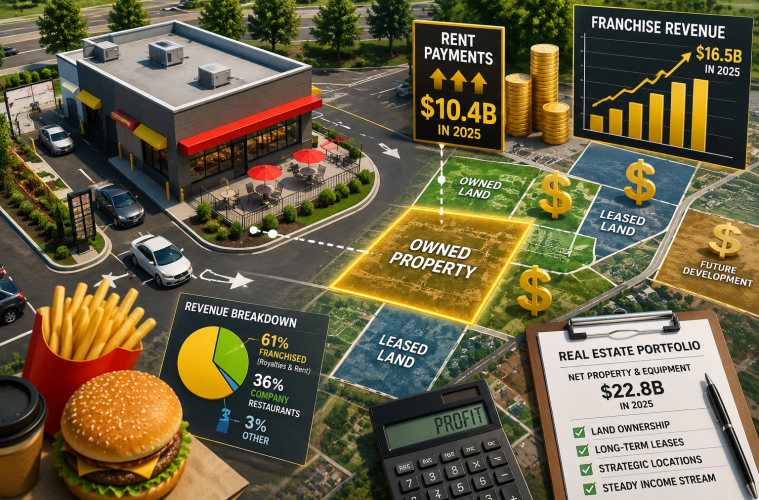
In 2025, McDonald’s reported approximately $10.4 billion in rent revenue from franchised restaurants.
That makes real estate a major part of the financial machine behind the Golden Arches.
McDonald’s Controls Billions in Property
The scale of the company’s restaurant property is enormous.
At the end of 2025, McDonald’s reported approximately $22.8 billion in net property and equipment associated with franchise arrangements.
That included billions of dollars worth of land.
Controlling restaurant locations gives McDonald’s another valuable advantage. Even when an individual franchise agreement ends, the company can often maintain control of the location and decide what happens next.
Why Franchising Is So Profitable
Operating restaurants is expensive.
There are employees, food costs, utilities, equipment, maintenance, insurance, and countless other expenses involved with keeping a restaurant running.
The franchise model shifts many of those operating responsibilities to independent franchisees.
Meanwhile, McDonald’s can collect royalties and rent from successful locations.
In 2025, franchised restaurants generated approximately 90% of McDonald’s restaurant margin dollars.
It’s easy to see why franchising has become such an important part of the company’s business.
McDonald’s Still Sells Plenty of Food
McDonald’s isn’t simply a real estate company disguised as a burger chain.
The company still directly operates thousands of restaurants.
Company-operated restaurants generated approximately $9.7 billion in sales for McDonald’s in 2025.
Those locations allow the company to earn directly from restaurant sales while also testing products, technology, and new ways of operating stores.
But the heavily franchised side of the business provides McDonald’s with a very different type of revenue stream.
The Restaurants and Real Estate Work Together
McDonald’s isn’t simply buying random pieces of commercial property and collecting rent.
The restaurant business and real estate strategy support each other.
A strong location can attract customers and generate restaurant sales.
Those sales generate royalties for McDonald’s, while the property itself can generate rental income.
The strength of the McDonald’s brand makes the restaurant location valuable, while controlling the location gives McDonald’s another way to profit from that value.
How Big Is McDonald’s Today?
McDonald’s generated approximately $26.9 billion in total company revenue in 2025.
About $16.5 billion came from franchised restaurants, while approximately $9.7 billion came from company-operated restaurant sales.
The company also had more than 45,000 restaurants worldwide by the end of the year.
Those numbers help explain why McDonald’s is much more than a place to grab lunch.
What Businesses Can Learn
McDonald’s demonstrates the power of building multiple revenue streams around one successful brand.
The company earns money when customers buy food, but its business model also allows it to benefit from franchise royalties and rent.
Rather than relying on a single source of revenue, McDonald’s built an ecosystem where its restaurants, franchisees, brand, and real estate all work together.
Final Thoughts
McDonald’s didn’t become a global giant simply by selling hamburgers.
It built an enormous franchise network supported by one of the most interesting real estate strategies in corporate America.
Customers may see burgers, fries, and drive-thru windows.
Behind them is a business collecting billions of dollars from restaurant sales, royalties, and rent.
That’s the real money behind McDonald’s.
Frequently Asked Questions
Does McDonald’s own the land under its restaurants?
McDonald’s owns some restaurant properties and leases others. In many traditional franchise arrangements, the company controls the restaurant location and collects rent from the franchisee.
How does McDonald’s make money from franchisees?
McDonald’s earns money from franchisees through royalties, rent, initial fees, and other payments associated with operating a McDonald’s restaurant.
Is McDonald’s really a real estate company?
McDonald’s is primarily a restaurant and franchising company, but real estate plays an unusually important role in its business model. The company controls many restaurant locations and collects substantial rental income from franchisees.
Disclosure: This article may contain affiliate links. If you purchase a product through one of our links, MoneyNation may earn a small commission at no additional cost to you. Please read our Affiliate Disclosure.
Helpful Products
- Check this out on Amazon: The Franchise MBA
- Check this out on Amazon: Restaurant Success by the Numbers
- Check this out on Amazon: The E-Myth Revisited
- Check this out on Amazon: Commercial Real Estate Investing for Dummies