
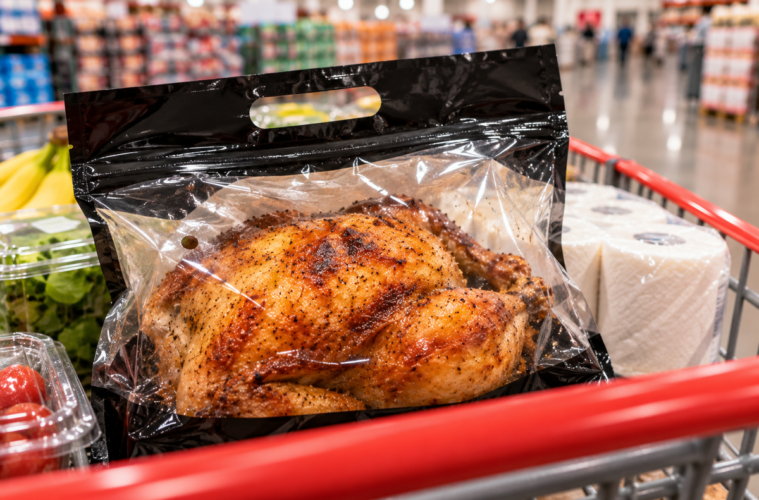
A whole cooked chicken for $4.99 sounds like a deal from another decade.
Yet Costco has made that price one of the most recognizable bargains in American grocery shopping.
While grocery prices have risen over the years, Costco’s famous rotisserie chicken has remained a fixture of its warehouse experience.
That raises an obvious question.
Why would a retailer keep selling such a popular product for so little when customers might willingly pay more?
The answer reveals something important about how Costco operates.
The chicken isn’t just dinner. It’s part of a much bigger retail strategy.
The $4.99 Chicken Is More Than a Grocery Item
Costco’s rotisserie chicken is one of the company’s signature products.
For shoppers, the appeal is straightforward. It’s convenient, inexpensive, and large enough to provide a meal or ingredients for several dishes.
For Costco, the value goes beyond the price of the chicken itself.
An inexpensive, familiar product gives shoppers another reason to visit the warehouse.
And once they’re inside, they encounter thousands of other products, from groceries and clothing to electronics and furniture.
A customer who originally planned to purchase a chicken might also pick up paper towels, coffee, produce, or household supplies.
Not every visit turns into a giant shopping trip, but the chicken helps reinforce Costco’s reputation as a place where customers can find unusually good value.
Why Costco Doesn’t Simply Raise the Price
From a traditional pricing perspective, keeping a popular product inexpensive might seem strange.
A company facing higher labor, transportation, and ingredient costs would normally consider increasing its selling price.
Costco takes a broader view.
Its business depends heavily on convincing members that paying an annual fee gives them access to worthwhile savings.
The $4.99 chicken is a particularly visible example of that promise.
Customers can easily compare its price with prepared chickens at other grocery stores.
That makes it a powerful reminder of what their membership can provide.
Raising the price might produce additional revenue from individual chickens, but it could also weaken one of Costco’s most recognizable symbols of value.
For a company built around customer loyalty, that trade-off matters.
Costco’s Chicken Business Is Bigger Than You Think
Costco sells well over 100 million rotisserie chickens annually.
That’s an enormous amount of business generated by a single prepared-food product.
And it creates an enormous supply-chain challenge.
Producing, transporting, cooking, and selling that many chickens requires coordination on a scale most grocery shoppers never see.
Even at a relatively low selling price, the sheer volume makes the chicken an important part of Costco’s grocery operation.
But the real value isn’t necessarily found in the revenue generated by the chickens themselves.
It’s in how they support the overall shopping experience.
Costco Built Its Own Chicken Supply Chain
One of the most interesting parts of Costco’s chicken strategy is that the company invested in producing its own poultry.
In 2019, Costco opened a major poultry processing operation in Fremont, Nebraska.
The operation, run by Lincoln Premium Poultry, helps supply Costco with chickens for its popular prepared-food program.
Instead of relying entirely on outside suppliers, Costco gained more direct control over part of the process, including poultry production and processing.
This approach is called vertical integration.
By controlling more stages of production, a company can potentially improve supply reliability, coordinate operations, and manage costs.
Of course, owning more of the supply chain also means taking on additional operational responsibilities and risks.
But for a company selling chickens by the millions, even relatively small improvements in efficiency can become financially significant.
Is Costco Actually Losing Money on Every Chicken?
The rotisserie chicken is frequently described as a loss leader.
A loss leader is a product sold at a very low price to attract customers who may purchase other items.
However, there’s an important distinction.
Costco does not publicly disclose a standalone profit margin for each rotisserie chicken.
That means outsiders cannot confidently calculate exactly how much the company earns or loses on every bird.
The better-supported conclusion is that Costco deliberately maintains a highly competitive price because the chicken provides value beyond its individual sale.
It attracts attention, reinforces the membership proposition, and helps distinguish Costco from other retailers.
Whether an individual chicken is profitable is only one part of the business decision.
The Membership Fee Changes the Equation
Costco isn’t a conventional supermarket.
Customers generally pay an annual membership fee to shop in its warehouses.
That changes the economics.
The company can emphasize low merchandise prices while collecting recurring membership revenue.
Costco’s business model depends on high sales volumes, efficient distribution, rapid inventory turnover, and relatively low merchandise margins.
The rotisserie chicken fits naturally into that model.
A member who repeatedly finds excellent value has another reason to renew.
And a member who renews may continue shopping at Costco throughout the following year.
That long-term relationship can be worth far more than squeezing another dollar out of a single chicken.
It’s also central to how Costco built its business around membership fees, rather than depending solely on traditional retail markups.
The Real Power Is the Shopping Trip
Consider two hypothetical shoppers.
The first visits a grocery store to buy a prepared chicken, pays for it, and leaves.
The second visits Costco to buy a rotisserie chicken but also purchases a package of paper towels, a bag of coffee, fruit, and laundry detergent.
Both stores sold a chicken.
But the second store also generated sales across several additional categories.
That doesn’t mean Costco profits from every shopping trip equally or that every chicken buyer makes impulse purchases.
It illustrates why retailers care about products that motivate customers to visit.
A popular item can support sales beyond its own category.
This is similar to the broader retail strategies used by companies such as Walmart and Target, where customer traffic, product selection, and shopping frequency all matter.
Why the Price Is Such Powerful Marketing
Most advertisements require a company to spend money telling customers why it offers good value.
Costco’s chicken helps demonstrate that message directly.
The price is easy to remember.
Customers talk about it.
News outlets write about it.
Shoppers compare it with alternatives.
That attention has marketing value, even though Costco doesn’t separately report a dollar figure for the publicity generated by its chicken.
It’s also a remarkably simple message.
Costco doesn’t need to explain a complicated rewards program or promotional pricing formula.
The customer sees a cooked chicken priced at $4.99.
The value proposition is immediately understandable.
Cheap Doesn’t Mean Cost-Free
There are also trade-offs behind low retail prices.
Large-scale poultry production raises questions about animal welfare, worker conditions, environmental impact, and food safety.
Producing millions of chickens requires substantial resources, including feed, water, transportation, energy, and labor.
These issues matter because an inexpensive retail price does not capture every economic, environmental, or social cost associated with producing a product.
The chicken’s popularity and Costco’s business success can be examined alongside those concerns.
What Other Businesses Can Learn From Costco
The lesson isn’t that every business should sell products for $4.99.
It’s that the value of a product isn’t always limited to its individual profit margin.
A product might help a company attract customers, encourage repeat visits, increase customer loyalty, or strengthen its reputation.
Businesses still need to understand their costs and maintain sustainable operations.
But the most profitable decision in the long run isn’t necessarily the one that maximizes profit on every individual transaction.
Sometimes a strategically priced product helps support the rest of the business.
Final Thoughts
Costco’s $4.99 rotisserie chicken has become more than a convenient dinner.
It’s a symbol of the retailer’s larger strategy.
The company uses low prices, operational scale, supply-chain investments, and membership loyalty to build relationships with customers.
The chicken doesn’t have to explain Costco’s entire business model.
It simply has to remind shoppers why they joined.
And that’s what makes a $4.99 product so valuable to one of the world’s largest retailers.
Frequently Asked Questions
Why is Costco’s rotisserie chicken $4.99?
Costco maintains the low price as part of its broader value strategy. The chicken helps attract shoppers and reinforces the appeal of Costco membership.
Does Costco lose money on its rotisserie chicken?
Costco doesn’t publicly disclose the precise profit or loss per chicken. Although the product is often described as a loss leader, its individual profitability cannot be independently confirmed from the company’s published financial statements.
Does Costco raise its rotisserie chicken price?
Costco has maintained the familiar $4.99 U.S. price for many years, although availability and pricing can vary by location and country.
Does Costco own a chicken processing plant?
Yes. Costco operates a vertically integrated poultry business through Lincoln Premium Poultry, which helps supply its rotisserie chicken program.
How many rotisserie chickens does Costco sell?
Costco sells more than 100 million rotisserie chickens annually, making the product one of its best-known prepared-food offerings.
Disclosure: This article may contain affiliate links. If you purchase a product through one of our links, MoneyNation may earn a small commission at no additional cost to you. Please read our Affiliate Disclosure.
Helpful Products
- Check this out on Amazon: Chicken Shredder Tool
- Check this out on Amazon: Glass Food Storage Containers
- Check this out on Amazon: Digital Meat Thermometer
- Check this out on Amazon: Chicken Carving Knife