


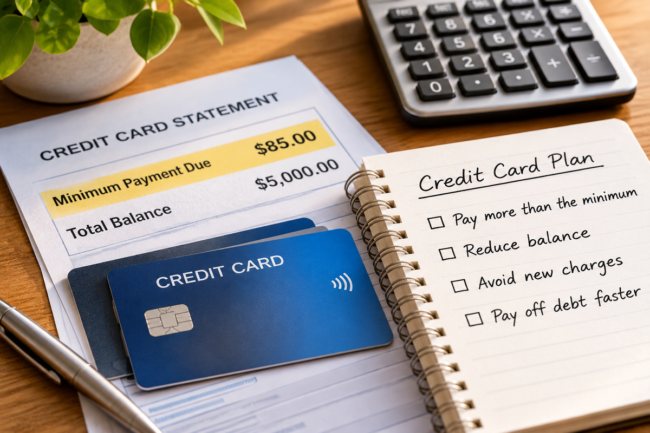
Your credit card bill arrives, and you see two numbers.
One is your total balance. The other is a much smaller minimum payment.
If money is tight, paying the minimum can feel like the obvious choice. You keep the account current, avoid a late payment, and have more cash available for everything else.
But there’s a catch.
Making only the minimum credit card payment can keep you in debt for years and cost you hundreds or even thousands of dollars in interest.
That’s because minimum payments are generally designed to keep your account in good standing, not to eliminate your debt quickly.
Here’s what actually happens when you pay only the minimum, why the balance can shrink so slowly, and how to get out of the cycle without completely wrecking your monthly budget.
What Is a Minimum Credit Card Payment?
A minimum credit card payment is the smallest amount your card issuer requires you to pay by the due date to keep your account current.
The amount varies by credit card company and your account terms.
Some issuers calculate it as a percentage of your outstanding balance. Others use a formula that includes interest, fees, and a portion of your principal.
For example, if you owe $3,000, your minimum payment might be around $60 to $100, depending on the card’s terms and interest rate.
Paying that amount on time generally helps you avoid late-payment penalties.
But it doesn’t mean you’re making much progress toward eliminating the balance.
Why Minimum Payments Keep You in Debt So Long
The biggest problem is interest.
When you carry a credit card balance, the issuer generally charges interest based on your account’s annual percentage rate, or APR.
A portion of your monthly payment goes toward those interest charges.
Only the remaining amount reduces what you actually owe.
And as your balance decreases, many credit card minimum-payment formulas also reduce the required payment.
That creates a frustrating situation.
You make payments every month, but your debt disappears much more slowly than expected.
How Much Does Paying the Minimum Really Cost?
Let’s look at a hypothetical example.
Suppose you have a credit card with the following details:
- Balance: $5,000
- Interest rate: 24% APR
- Monthly minimum payment: Determined by the card issuer’s payment formula
- No additional purchases or fees
Assume the interest rate stays constant and interest is calculated monthly for simplicity.
When your minimum payment barely covers the interest, your balance may decrease extremely slowly.
Depending on your card’s payment formula, repayment could take many years and cost thousands of dollars in interest.
Actual results depend on your issuer’s minimum-payment formula, daily interest calculations, fees, and changes in APR.
But the broader lesson is the same.
A small required payment can turn a manageable balance into a very expensive long-term obligation.
Why Your Credit Card Balance Barely Moves
Imagine you owe $5,000 at 24% APR.
Using a simplified monthly calculation, the first month’s interest would be approximately $100.
If your payment is $100, nearly all of that money could go toward interest.
That means your principal balance would barely change.
The following month, interest would be calculated on almost the same amount.
This is why paying only the minimum can feel like running on a treadmill.
You’re making an effort, but you’re barely moving forward.
The situation becomes even more expensive if you continue using the card for new purchases.
What Happens to Your Credit Score?
Paying the minimum on time is generally better for your credit history than missing payments.
Payment history is an important factor in credit scoring.
However, carrying a large balance can still affect your score through credit utilization.
Credit utilization measures how much of your available revolving credit you’re using.
For example, if your credit card has a $6,000 limit and you owe $5,000, your utilization is approximately 83%.
That’s relatively high.
Even if you make every minimum payment on time, a high balance relative to your credit limit can negatively affect your credit score.
Reducing your balance may improve your utilization and potentially benefit your credit over time.
Is Paying the Minimum Ever a Good Idea?
Sometimes, yes.
If you’re facing a temporary financial emergency, making the minimum payment can help you avoid becoming delinquent while you address more urgent expenses.
For example, paying the minimum may be appropriate when you’re dealing with a temporary reduction in income or an unexpected essential expense.
The key is recognizing the difference between a short-term strategy and a long-term habit.
Paying the minimum for a month or two during a difficult period is different from doing it indefinitely.
If you consistently can’t afford more than the minimum, that’s a sign your debt repayment plan may need to change.
What Happens If You Pay More Than the Minimum?
Even modest additional payments can make a meaningful difference.
Let’s use the same hypothetical $5,000 balance at 24% APR.
Instead of paying only the minimum, suppose you pay a fixed $200 every month.
Under a simplified monthly-interest calculation, you could eliminate the debt in approximately 36 months.
Your total interest would be roughly $2,000.
That’s a dramatic improvement compared with making declining minimum payments.
And if you can afford $250 monthly, you could potentially pay off the balance even faster.
The important distinction is that your payment stays consistent rather than shrinking along with the minimum required amount.
How Fixed Payments Help You Pay Off Credit Card Debt Faster
Here’s an illustrative comparison using a $5,000 balance at 24% APR and no new purchases.
| Payment Strategy | Approximate Payoff Time |
|---|---|
| Fixed $150 per month | About 56 months |
| Fixed $200 per month | About 36 months |
| Fixed $250 per month | About 26 months |
These figures are estimates using simplified monthly interest and assumed payment rules. Your actual credit card terms may produce different results.
The takeaway is that consistently paying more than the minimum can substantially reduce the time you’re in debt.
How to Stop the Minimum Payment Cycle
You don’t need to eliminate every unnecessary expense overnight.
But you do need a plan that gradually reduces your balance.
1. Stop Adding New Purchases When Possible
It’s difficult to pay down a credit card when new charges keep replacing the amount you’ve paid off.
If possible, temporarily switch to a debit card or cash for everyday purchases.
The goal is to prevent the balance from growing while you work on reducing it.
2. Choose a Fixed Monthly Payment
Instead of paying whatever minimum appears on your statement, choose a fixed amount you can realistically afford.
For example, if your current minimum is $85, you might aim for $110 or $125 each month.
As your required minimum decreases, keep your chosen payment the same.
That helps more money go toward reducing your principal over time.
3. Consider the Debt Avalanche Method
If you have several credit cards, the debt avalanche method focuses additional payments on the account with the highest interest rate first.
This approach generally minimizes interest costs when compared with paying lower-rate debts first, assuming the same total payment budget.
Another option is the debt snowball method, which prioritizes the smallest balance for quicker psychological wins.
Understanding debt snowball vs. debt avalanche can help you choose a strategy you’ll actually stick with.
4. Ask Your Credit Card Company About Lower Rates
You may be able to request a lower interest rate.
There’s no guarantee your issuer will agree, but asking is generally free.
You can also inquire about hardship programs if you’re struggling to keep up with payments.
A reduced APR can help more of each payment go toward the balance.
Before accepting any hardship arrangement, ask how it affects your account terms, credit limit, and credit reporting.
5. Look for Small Expenses You Can Redirect
You don’t necessarily need hundreds of extra dollars to begin making progress.
Review subscriptions, recurring services, and other spending categories.
You may discover monthly bills you’re probably overpaying that could be reduced or eliminated.
Redirecting even $25 or $50 a month toward your credit card can make a difference over time.
6. Build a Small Emergency Cushion
Paying down debt is important, but having no emergency savings can make it easy to fall back into borrowing.
Even a modest savings cushion can help cover unexpected expenses without immediately adding them to a credit card.
If you don’t have any savings, consider building an emergency fund even when you’re starting at $0 while continuing to make required debt payments.
The right balance depends on your income, expenses, and financial stability.
Should You Use a Balance Transfer Credit Card?
A balance transfer card may offer a promotional 0% APR for a limited period.
That can reduce interest costs while you pay down an existing balance.
However, balance transfers often involve fees, and promotional rates eventually expire.
You also need to understand what happens if you don’t pay the transferred balance before the promotional period ends.
A balance transfer can be useful when you have a realistic repayment plan.
It isn’t a solution if you continue accumulating new debt.
Compare the fees, promotional terms, and regular APR before making a decision.
What If You Can’t Afford the Minimum Payment?
If you’re struggling to make even the minimum payment, don’t ignore the situation.
Contact your credit card issuer as soon as possible.
Explain that you’re experiencing financial difficulty and ask whether hardship assistance is available.
Some issuers may offer temporary payment arrangements or other options.
You can also consider speaking with a reputable nonprofit credit counseling organization.
A counselor may help you review your budget, understand your options, and determine whether a debt management plan makes sense.
Be cautious of companies promising to erase credit card debt quickly or guaranteeing results.
And remember that missing payments can lead to late fees, credit damage, and potentially collections activity.
Addressing the problem early usually gives you more options.
Final Thoughts
The minimum credit card payment exists to keep your account current.
It isn’t necessarily designed to help you become debt-free quickly.
When interest rates are high, making only the minimum can stretch repayment over many years.
But the solution doesn’t always require a dramatic financial overhaul.
Choosing a fixed payment, avoiding new charges, reducing your interest rate when possible, and directing extra money toward your balance can all help.
The sooner you start reducing the principal, the less money you’ll generally spend on interest.
And that’s money you can eventually put toward something other than your credit card company.
Frequently Asked Questions
Is it bad to only pay the minimum on a credit card?
Paying the minimum on time generally prevents your account from becoming past due, but it can result in substantial interest charges and a very long repayment period.
Does paying only the minimum hurt your credit score?
Making the minimum payment on time helps maintain a positive payment history. However, carrying a high balance can negatively affect your score through credit utilization.
How long does it take to pay off a credit card with minimum payments?
It depends on your balance, APR, and issuer’s payment formula. At high interest rates, paying only declining minimums can extend repayment for many years.
Will paying $50 more than the minimum help?
Yes. Additional payments generally reduce your balance faster and lower future interest charges, assuming you aren’t adding new purchases.
What happens if I pay less than the minimum?
Paying less than the required minimum can result in your account being treated as past due, potentially triggering late fees, credit reporting consequences, and other penalties.
Is it better to pay off a credit card or save money?
It depends on your financial situation. High-interest credit card debt is expensive, but having some emergency savings can help prevent future borrowing. Many households benefit from balancing both priorities.