
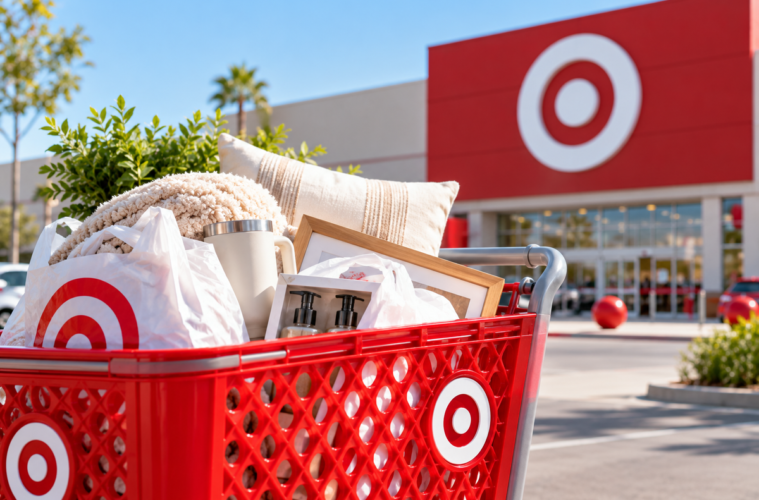
Walk into Target for toothpaste and somehow leave with throw pillows, snacks, children’s clothes and a candle you absolutely did not need.
That joke has become part of Target’s identity, but behind the impulse purchases is a massive and increasingly complicated business.
Target generated about $104.8 billion in net sales in 2025, including roughly $102.7 billion from merchandise. But selling products isn’t the only way the company makes money anymore. Target also generates revenue from advertising, its credit-card partnership, memberships and its online marketplace.
Here’s the money behind Target.
Target Is Still a $100 Billion Retail Machine
The overwhelming majority of Target’s revenue still comes from selling merchandise.
In 2025, Target reported approximately:
- $24.1 billion in food and beverage sales
- $18.0 billion in household essentials
- $15.8 billion in hardlines
- $15.7 billion in apparel and accessories
- $15.6 billion in home furnishings and décor
- $13.2 billion in beauty
Altogether, merchandise sales reached approximately $102.7 billion.
That enormous variety is an important part of Target’s strategy.
A customer might visit because they need groceries or shampoo, but once they’re inside, Target has opportunities to sell clothing, home décor, toys, electronics and dozens of other higher-value items.
The grocery aisle can get you through the door.
The rest of the store gets a shot at your wallet.
Target’s Stores Do More Than Sell Products
Target’s physical stores have become one of its most important digital assets.
That sounds backward until you look at how online orders are actually fulfilled.
In each of the past three years, Target says its stores fulfilled more than 97% of total merchandise sales. In 2025, roughly two-thirds of digital sales were fulfilled using same-day services.
Stores can serve customers shopping normally while also functioning as local fulfillment centers for:
Order Pickup.
Drive Up.
Same-day delivery.
Online orders shipped from stores.
That allows Target to use real estate and inventory it already has instead of building an entirely separate network for every online order.
Digital Sales Are Already Enormous
Target generated approximately $21.1 billion in digitally originated merchandise sales in 2025.
That’s up from $20.5 billion in 2024 and $19.4 billion in 2023.
And the line between an “online” and “store” sale is increasingly blurry.
You might order something on your phone while sitting on your couch, but the product may ultimately come from a Target store a few miles away.
That’s why the company’s stores are so important even as shopping shifts online.
Target’s Own Brands Are a Powerful Weapon
One of Target’s biggest advantages is that it doesn’t have to rely exclusively on national brands.
Its portfolio includes Target-owned brands across clothing, food, home goods, beauty and household essentials.
This is part of the same retail battle that helps explain how Walmart uses scale and low prices to make billions.
Brands such as Good & Gather, Cat & Jack, up & up and others give Target products shoppers can’t simply price-check against an identical item at another retailer.
Target reported in its 2024 fiscal-year filing that 11 of its owned brands generated more than $1 billion in annual sales each.
Owned brands can help retailers differentiate themselves while giving them more control over pricing, design and product selection.
And if someone falls in love with a particular Target-exclusive product, there’s an obvious place they have to return to buy another one.
Target Has Built an Advertising Business
This may be the most interesting part of Target’s business that many shoppers never think about.
Target operates an advertising business called Roundel.
Brands pay to advertise products to Target shoppers across digital platforms.
In 2025, Target reported $915 million in advertising revenue, up from $649 million in 2024 and $522 million in 2023.
That’s a roughly 75% increase in reported advertising revenue in just two years.
Target has access to something advertisers desperately want: shopping data.
The company knows what people search for and buy across its ecosystem. That information can help brands place advertisements in front of shoppers who are more likely to be interested in their products.
Target has said it plans to continue expanding Roundel and has set a goal of doubling the size of the business by 2030.
So Target isn’t merely selling shelf space anymore.
It’s selling attention.
The Target Circle Card Makes Money Too
Then there’s the Target Circle Card.
Target shoppers can receive a 5% discount on most purchases when using eligible Target Circle Cards.
But Target doesn’t simply operate the credit-card business itself.
TD Bank owns and funds Target’s credit-card receivables, while Target performs servicing and marketing functions. Target receives a percentage of profits generated by those receivables under its agreement with TD.
In 2025, Target recorded approximately $522 million in credit-card profit-sharing revenue.
That creates another revenue stream connected to the same customers already shopping at Target.
And the discount gives cardholders another reason to keep returning.
Target Circle Is About More Than Discounts
Target has expanded Target Circle into a broader loyalty ecosystem.
There’s a free Target Circle program, Target Circle Cards and a paid Target Circle 360 membership.
Circle 360 includes benefits such as same-day delivery on eligible orders over $35 and free shipping on eligible purchases.
The membership fee itself creates revenue, but the larger goal is straightforward.
Get customers shopping at Target more frequently.
Target previously reported that active Circle members spent an average of three times as much as nonmembers, while customers who added Circle 360 spent an average of eight times as much. Those figures describe Target’s reported 2024 customer behavior rather than a guarantee about individual shoppers.
A loyalty program isn’t particularly valuable if customers simply collect discounts.
Membership and loyalty can also transform retail economics, something you can see in how Costco built its business around membership fees.
It’s valuable when it changes where they spend their money.
Target Plus Lets Other Companies Sell to Target Customers
Target also operates Target Plus, its third-party digital marketplace.
This allows selected outside sellers to offer products through Target’s digital ecosystem.
Instead of owning every product being sold, Target can earn commissions on third-party marketplace transactions.
Target said Target Plus generated approximately $1 billion in third-party digital sales in 2024 and has laid out plans to grow that figure to more than $5 billion by 2030.
It’s another way Target can make its website more useful without having to stock every item itself.
So Where Does Target Actually Make Its Money?
The business is increasingly built around several interconnected pieces.
Customers buy merchandise.
Stores fulfill both physical and digital purchases.
Owned brands encourage shoppers to buy products they can’t find elsewhere.
Target Circle encourages repeat visits.
Target Circle Cards generate profit-sharing income.
Roundel sells advertising access to shoppers.
Target Plus brings third-party sellers onto the platform.
Circle 360 generates membership revenue and encourages customers to use Target for convenient delivery.
Each part makes the others potentially more valuable.
That ecosystem is much harder to replicate than simply opening another big-box store.
Target Isn’t Growing Everywhere
Target is still enormous, but its recent financial results haven’t all moved in the right direction.
Net sales declined from approximately $106.6 billion in 2024 to $104.8 billion in 2025.
Operating income fell from roughly $5.6 billion to $5.1 billion, while net earnings declined from about $4.1 billion to $3.7 billion.
Target itself has acknowledged that recent results have fallen short of what the company expects over time.
That makes newer businesses such as advertising, memberships and the marketplace particularly interesting.
Target isn’t abandoning retail.
It’s trying to make each customer relationship generate value in more ways.
Final Thoughts
Target’s business looks simple from the parking lot.
Buy products wholesale. Put them on shelves. Sell them for more.
But modern Target is considerably more complicated.
Its roughly $105 billion business combines traditional retail with private-label brands, digital fulfillment, advertising, memberships, a marketplace and credit-card profit sharing.
The same customer who walks into Target to buy groceries can also become a Circle member, use a Target Circle Card, see a paid advertisement, buy an owned-brand product and place another order through the app later that evening.
And that may be the real secret behind Target’s business.
Getting you into the store is valuable.
Finding more ways to make money after you’re already there is even better.
Frequently Asked Questions
How much money does Target make?
Target reported approximately $104.8 billion in net sales for 2025 and about $3.7 billion in net earnings.
What is Target’s biggest source of revenue?
Merchandise sales are by far Target’s largest revenue source. They totaled approximately $102.7 billion in 2025.
Does Target make money from advertising?
Yes. Target operates the Roundel advertising business and reported $915 million in advertising revenue in 2025.
Does Target make money from its credit cards?
Target receives profit-sharing income through its credit-card agreement with TD Bank. That revenue totaled approximately $522 million in 2025.
How important are Target stores to online shopping?
Very important. Target says stores fulfilled more than 97% of total merchandise sales in each of the last three years, including purchases that originated digitally.
Disclosure: This article may contain affiliate links. If you purchase a product through one of our links, MoneyNation may earn a small commission at no additional cost to you. Please read our Affiliate Disclosure.
Helpful Products
- Check this out on Amazon: Reusable Shopping Bags
- Check this out on Amazon: Grocery Cart Organizer
- Check this out on Amazon: Budget Planner
- Check this out on Amazon: Coupon Organizer